How Arsenal’s Tactical Identity Evolved
The transition from Highbury to the Emirates Stadium represents far more than a simple change of address in North London. It marks a fundamental shift in how Arsenal conceives, constructs, and executes its footballing strategy on the pitch. While fans often romanticize the intoxicating flair of the early Arsène Wenger years, Mikel Arteta has methodically crafted a modern tactical machine built on control and geometric discipline. Understanding this evolution reveals how spatial dynamics and squad philosophy have continuously reshaped one of football’s most iconic institutions.
From Highbury’s Intimate Fluidity to Modern Spatial Geometry
Highbury’s compact dimensions naturally fostered an environment of high-speed technical combination play. Arsène Wenger capitalized on these tight spatial boundaries by encouraging absolute expressive freedom, allowing legendary figures like Thierry Henry and Robert Pires to drift seamlessly across central and wide zones. The football was inherently instinctual, relying on the telepathic understanding between world-class athletes rather than rigid positional guidelines. Players occupied spaces reactively, creating an unpredictable, counter-attacking juggernaut that dynamic teams struggled to contain.
The move to the sprawling, expansive pitch at the Emirates Stadium exposed the limitations of relying purely on intuitive movement. Opponents quickly learned that deep defensive blocks could exploit the added width and length, neutering Arsenal’s quick interchange play. As European football evolved toward structured pressing and strict tactical discipline, the Gunners’ romanticized fluidity began to yield diminishing returns, eventually necessitating a complete philosophical overhaul at the managerial level.
Mikel Arteta’s Positional Play and Strategic Evolution
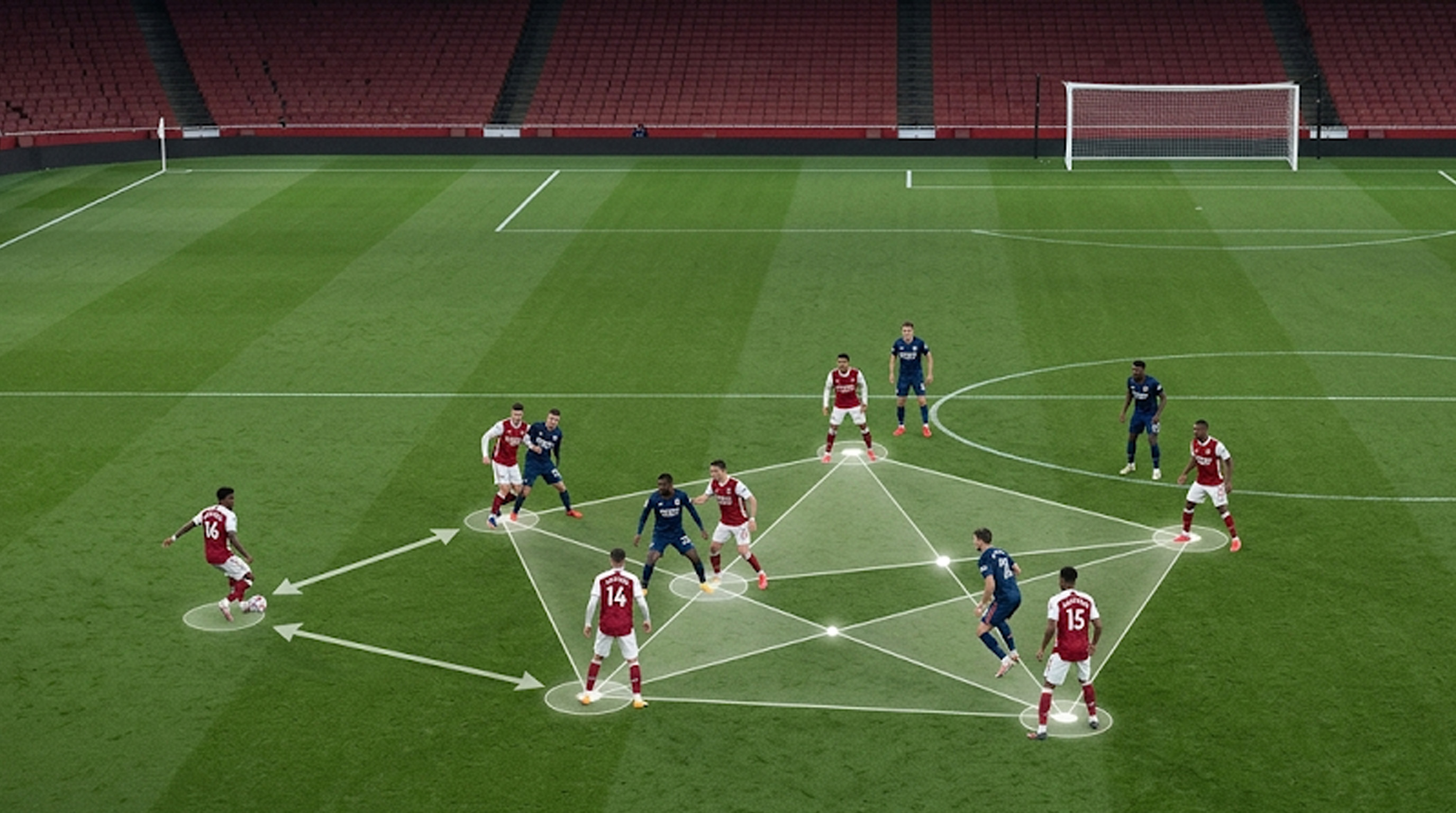
Under Mikel Arteta, Arsenal has embraced Juego de Posición, or Positional Play, transforming the team into a masterclass of spatial control. Rather than allowing players to move freely based on instinct, Arteta assigns strict zone-based responsibilities designed to manipulate the opponent’s defensive structure. The pitch is mapped out into explicit corridors, ensuring that when an inverted fullback moves into the central midfield channel, a wide winger simultaneously pins the opposition fullback to maintain optimal numerical advantages.
This structural evolution prioritizes risk mitigation and sustained territorial dominance over sheer counter-attacking speed. By maintaining meticulous distance between positions, the current squad minimizes turnovers in dangerous areas and sets up instant counter-pressing traps when possession is lost. The transition from Wenger’s artistic improvisation to Arteta’s calculated geometry reflects the broader macro-trends of contemporary elite football, proving that modern dominance requires absolute structural authority.